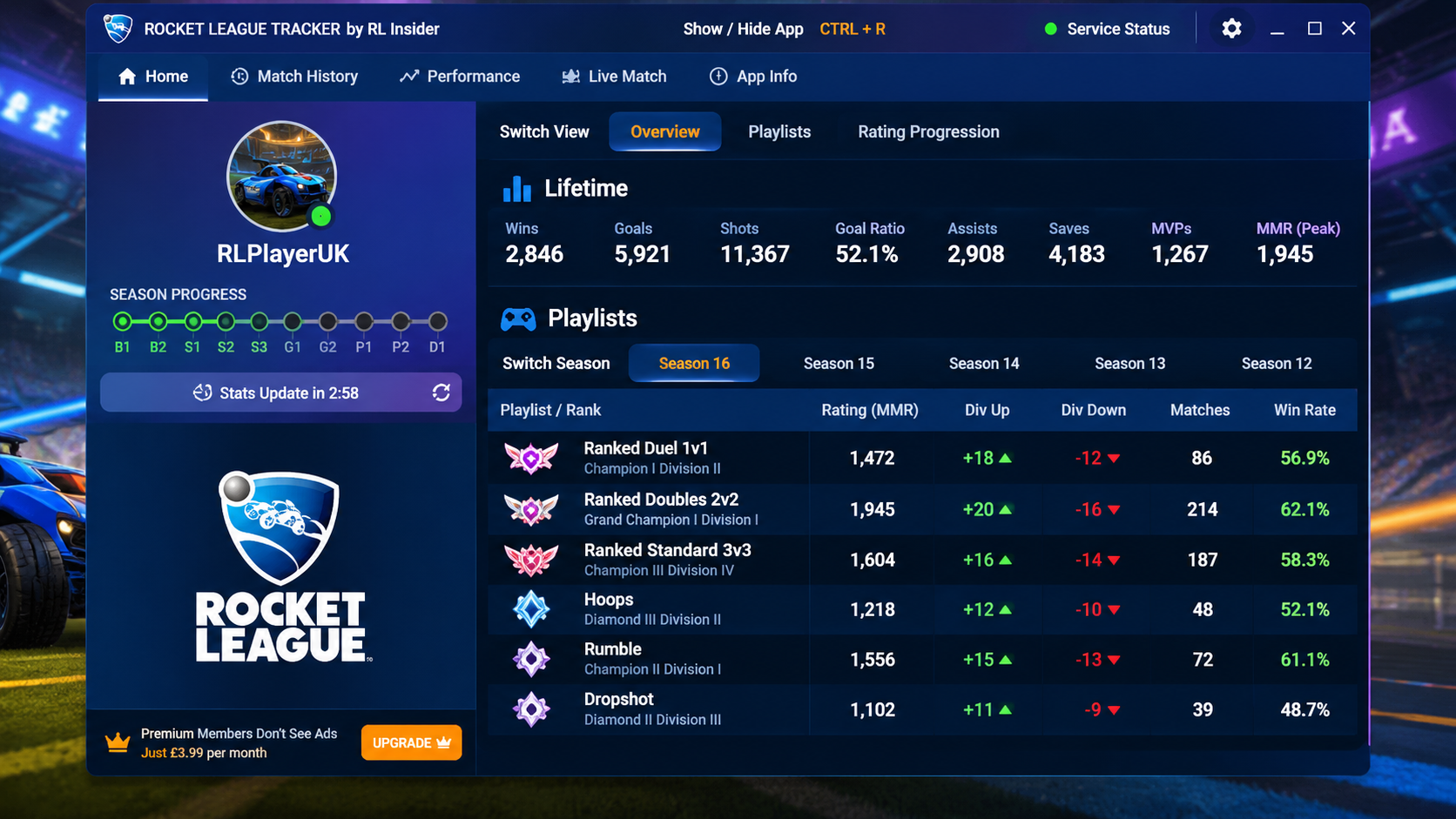
Rocket League is one of the most competitive multiplayer games, combining football-style gameplay with high-speed vehicles, aerial mechanics and strategic teamwork. As players aim to improve their rankings, understanding individual performance becomes increasingly important.
This is where Rocket League tracker tools become valuable. These platforms help players monitor their matchmaking rating (MMR), win percentage, goals, assists, saves and competitive progress.
Whether you are a beginner learning basic mechanics or an experienced player aiming for Grand Champion, tracking performance can reveal strengths, weaknesses and opportunities for improvement.
With several tracking platforms available, choosing the right one depends on the statistics you want to monitor and how seriously you approach competitive gaming.
What Are Rocket League Tracker Tools and Why Are They Important?
Rocket League tracker tools are websites, applications and replay-analysis platforms that collect or display gameplay statistics.
Instead of relying entirely on match results, players can examine their performance across multiple competitive sessions.
For example, a player might win several matches while struggling with defensive positioning. A tracker can highlight rating improvements, while replay-analysis software can reveal the mistakes that ordinary scoreboards overlook.
Which Rocket League Statistics Should Players Monitor?
The most useful performance indicators include matchmaking rating, competitive rank, win percentage, shooting accuracy, goals, assists and saves.
More advanced tools can examine boost consumption, positioning, movement patterns and defensive rotations.
Tracking these statistics over time helps players recognise whether their improvement is consistent or simply the result of a short winning streak.
What Are the Best Rocket League Tracker Tools?
Several platforms provide useful tracking features, although they serve different purposes.
Some focus on competitive rankings, while others offer detailed replay analysis or live gameplay information.
1. Tracker Network – Best for Competitive Rankings
Website: https://rocketleague.tracker.network/
Tracker Network is among the best-known platforms for monitoring Rocket League statistics.
Players can search supported profiles, examine competitive rankings and compare their performance with other players.
The platform provides MMR progression, seasonal statistics, match history and leaderboards.
Its Windows desktop application also offers live match scouting and performance information, making it particularly useful for competitive PC players.
Tracker Network is a practical choice for players who want to understand how their rankings change throughout a season.
2. Ballchasing – Best for Detailed Replay Analysis
Website: https://ballchasing.com/
Ballchasing takes a different approach by analysing uploaded Rocket League replay files.
Rather than focusing exclusively on rankings, it examines gameplay mechanics and positioning.
Players can review boost usage, movement speed, time spent in different areas of the pitch and distances between teammates.
Its browser-based 3D replay viewer also helps identify rotation mistakes and positioning problems.
For players interested in improving their decision-making, Ballchasing offers valuable information that basic rank trackers cannot provide.
3. OmniStats – Best for Live Match Insights
Website: https://omnistats.org/
OmniStats provides a Rocket League overlay and dashboard designed to display competitive information during gameplay.
Its features include live lobby rankings, MMR graphs, player history and private notes about opponents.
Players can also review their previous results with or against particular competitors.
The platform supports second-screen dashboards, allowing players to monitor information without constantly switching away from the game.
As with any third-party gameplay companion, users should verify current compatibility with Rocket League’s anti-cheat requirements before installation.
4. Official Rocket League Statistics – Best for Beginners
Rocket League also provides built-in statistics and competitive information.
Players can examine their career achievements, match performance and ranking progress without installing additional software.
In 2026, the game introduced an option to display numerical Competitive MMR directly, reducing the need for third-party software when checking current ratings.
For casual players and beginners, these built-in features may provide everything needed to monitor basic improvement.
How Do the Best Rocket League Tracker Tools Compare?
The following table compares the main features and ideal users of each tracking option.
| Tracker tool | Main features | Best for |
|---|---|---|
| Tracker Network | MMR, rankings, match history, leaderboards | Competitive players |
| Ballchasing | Replay analysis, boost usage, positioning | Advanced improvement |
| OmniStats | Live match data, MMR graphs, player history | PC players |
| Official Rocket League Stats | Career statistics, ranks, in-game MMR | Beginners |
Each tool has different advantages. Players seeking detailed competitive rankings may prefer Tracker Network, while those wanting to understand mechanical and tactical mistakes may benefit more from Ballchasing.
How Can Rocket League Trackers Help Improve Competitive Performance?
Tracking statistics becomes more valuable when players use the information to improve specific gameplay skills.
A higher rank does not necessarily mean every aspect of a player’s performance has improved.
For example, a player may score frequently but lose matches because of poor rotations or unnecessary defensive challenges.
Understanding these patterns requires combining statistical information with gameplay analysis.
For additional guidance on competitive rankings, gameplay strategies and tracking developments, players can explore RL Insider, which provides information about Rocket League performance, MMR and competitive progression.
How Can Players Identify Their Weaknesses?
Players should begin by reviewing several matches rather than judging performance from a single result.
A consistent pattern of conceding goals after unsuccessful challenges may indicate positioning problems.
Similarly, low shooting accuracy could suggest that a player needs to practise shot placement rather than simply attempting more shots.
Replay-analysis platforms can help players understand these issues by showing their movement and positioning throughout matches.
Why Is Monitoring MMR Progression Important?
Matchmaking Rating is a numerical measure used within Rocket League’s competitive ranking system.
Monitoring MMR over time helps players understand whether their results are producing sustainable progress.
However, individual match rating changes should not be treated as a complete measure of skill.
Players should examine performance across multiple sessions and compare results within the same competitive playlist.
Which Performance Metrics Matter Most in Rocket League?
Although tracker platforms display numerous statistics, certain metrics are particularly useful for understanding competitive performance.
Win Percentage and Match Consistency
Win percentage measures how frequently a player wins matches.
For example, winning 30 matches out of 50 produces a 60% win rate.
However, maintaining that percentage over hundreds of matches is more meaningful than achieving it during a short session.
Shooting Accuracy and Goal Conversion
Shooting accuracy indicates how effectively players convert shots into goals.
A player who repeatedly takes difficult shots from poor positions may have a lower conversion rate than someone who prioritises controlled opportunities.
Improving shot selection can therefore be just as important as improving mechanical accuracy.
Defensive Positioning and Boost Management
Defensive performance involves more than collecting saves.
Strong players maintain effective positioning, rotate appropriately and manage boost resources.
Ballchasing can help examine these factors through replay-based movement and boost statistics.
Players should interpret these numbers alongside gameplay footage because high boost consumption or frequent saves are not automatically indicators of better performance.
How Can Players Build a Better Rocket League Training Routine?
Using tracking software effectively requires a structured approach.
Players should select one competitive playlist and establish a performance baseline across approximately 20 to 30 matches.
After identifying recurring mistakes, they can focus training sessions on specific improvements.
For example, someone struggling with aerial accuracy might practise aerial control before reviewing subsequent match results.
Players can also explore technology and gaming-related resources on Page Contacts to discover broader digital topics alongside their competitive gaming interests.
Why Should Players Combine Statistics With Replay Reviews?
Statistics reveal what happened, while replays often explain why it happened.
A player might record several defensive saves but repeatedly leave teammates exposed through poor rotations.
Without replay analysis, the underlying problem could remain unnoticed.
Combining performance tracking with regular replay reviews creates a more complete understanding of competitive gameplay.
Are Rocket League Tracker Tools Safe to Use?
Browser-based statistics platforms generally allow players to review available performance data without modifying the game.
Desktop overlays and gameplay modifications require additional consideration.
Rocket League introduced Easy Anti-Cheat for online PC gameplay in April 2026, affecting compatibility with certain third-party modifications.
Players should download software only from official developer websites and check current game rules before using overlays or plugins.
The Entertainment Software Rating Board (ESRB) provides nonprofit guidance on video game ratings and online gaming safety.
Similarly, the National Society for the Prevention of Cruelty to Children (NSPCC) offers UK guidance on safer online gaming, including privacy, communication and digital wellbeing.
These resources are particularly relevant for younger players using gaming communities and external websites.
What Is the Best Rocket League Tracker for Different Skill Levels?
The ideal tracking platform depends on a player’s experience and competitive goals.
Beginners may find official in-game statistics sufficient for understanding basic progression.
Intermediate players can benefit from Tracker Network’s ranking history and competitive comparisons.
More experienced players may prefer Ballchasing for reviewing positioning, boost efficiency and tactical decision-making.
Dedicated PC competitors may also find live match dashboards useful, provided the software remains compatible with the game’s current requirements.
Ultimately, using multiple complementary tools can provide a more complete picture than relying on a single performance statistic.
Conclusion
The best Rocket League tracker tools help players understand their competitive progress, identify weaknesses and make more informed training decisions.
Tracker Network is particularly useful for monitoring rankings and MMR, while Ballchasing provides deeper gameplay analysis. OmniStats offers live information for supported PC setups, and Rocket League’s built-in statistics remain a convenient starting point.
However, tracking performance alone will not guarantee higher rankings.
Consistent practice, effective teamwork, strong positioning and regular replay reviews remain essential.
By combining reliable statistics with targeted training, players can develop a clearer understanding of their abilities and work towards long-term competitive improvement.